
4PL vs. 3PL
As supply chains become more complex, businesses are looking beyond simply moving products from point A to point B. Customers expect faster delivery, greater visibility, and consistent service regardless of where products originate or where they're delivered. Meeting those expectations requires more than transportation—it requires strategic supply chain management.
For many companies, the decision comes down to choosing between a Third-Party Logistics (3PL) provider and a Fourth-Party Logistics (4PL) partner. While both models offer valuable services, they serve different purposes. Understanding the differences can help businesses choose the solution that supports long-term growth, operational efficiency, and customer satisfaction.
What Is a 3PL?
A Third-Party Logistics (3PL) provider is responsible for executing logistics functions on behalf of a business. Common services include transportation, warehousing, inventory management, order fulfillment, freight brokerage, and distribution.
A 3PL essentially becomes an extension of your operations, helping you outsource logistics activities that would otherwise require significant internal resources.
Businesses often choose a 3PL when they need:
• Warehousing and storage
• Freight transportation
• Pick-and-pack fulfillment
• Inventory management
• Last-mile delivery
• Returns processing
For many small and mid-sized companies, a 3PL offers an affordable way to improve logistics without investing in additional facilities, employees, or transportation assets.
What Is a 4PL?
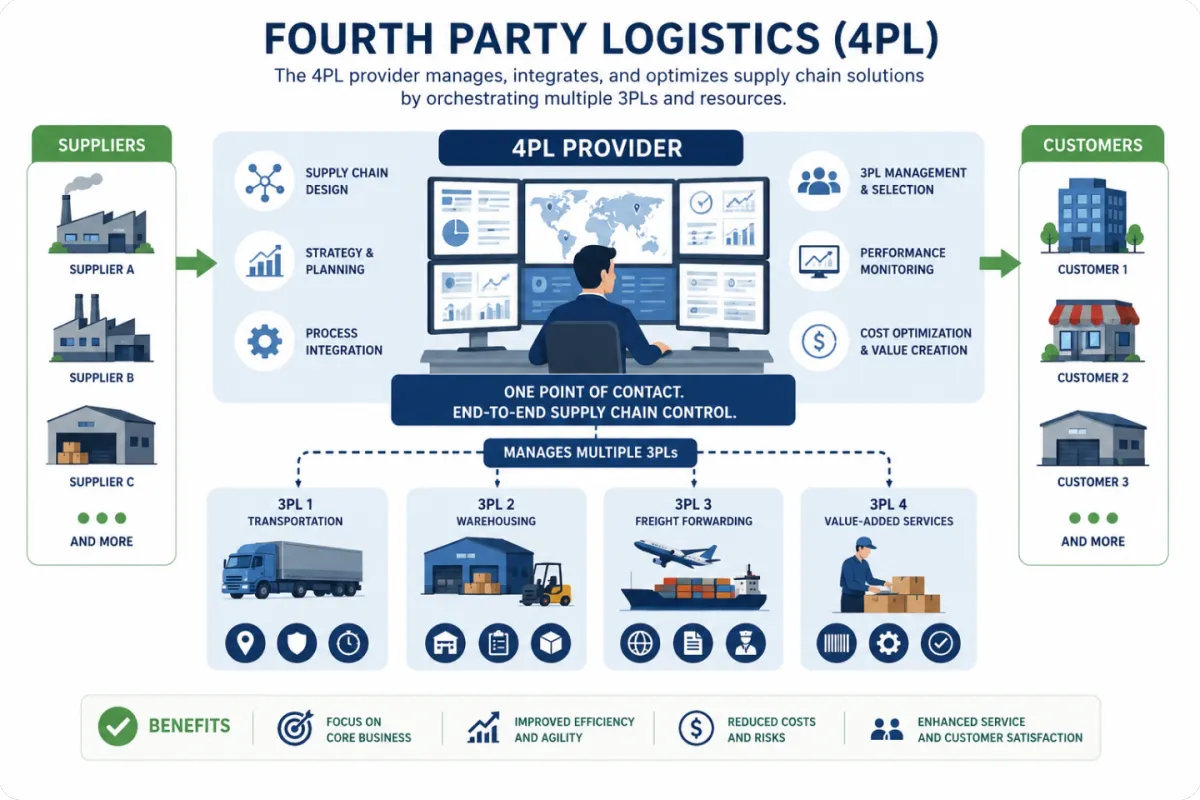
A Fourth-Party Logistics (4PL) provider takes logistics management to the next level. Rather than simply performing logistics services, a 4PL manages the entire supply chain. They act as a single point of contact, coordinating multiple 3PLs, carriers, warehouses, technology platforms, customs brokers, and suppliers to optimize every aspect of logistics operations.
Think of a 4PL as the architect of your supply chain rather than one of the contractors.
A 4PL typically provides:
End-to-end supply chain management
Strategic logistics planning
Carrier procurement and management
Transportation optimization
Technology integration
Data analytics and reporting
Inventory optimization
Vendor management
Continuous process improvement
Risk management and contingency planning
Instead of focusing on individual shipments, a 4PL focuses on improving the overall performance of your supply chain.
Why Businesses Are Moving Toward 4PL Solutions
As businesses grow, logistics often becomes increasingly fragmented. One warehouse may serve the western United States while another handles the East Coast. Different carriers may specialize in parcel shipments, LTL freight, or international transportation. Inventory systems, order management software, and customer service platforms may not communicate effectively.
Managing all of these moving parts internally can consume valuable time and resources.
A 4PL simplifies this complexity by overseeing the entire logistics network, allowing business leaders to focus on growth instead of day-to-day supply chain management.
Greater Supply Chain Visibility
One of the biggest advantages of a 4PL is complete visibility across the supply chain.
Instead of receiving separate reports from multiple providers, businesses gain access to consolidated data that shows inventory levels, transportation performance, shipping costs, carrier metrics, and fulfillment efficiency in one place. This visibility enables companies to identify bottlenecks faster, make better forecasting decisions, and respond quickly to disruptions.
Lower Overall Logistics Costs
At first glance, some companies assume that adding a 4PL creates another layer of expense. In reality, a skilled 4PL often reduces total logistics costs through optimization.
Rather than simply negotiating freight rates, a 4PL evaluates the entire supply chain to identify opportunities such as:
Eliminating redundant transportation
Reducing inventory carrying costs
Improving warehouse utilization
Selecting more efficient shipping modes
Consolidating freight
Reducing accessorial charges
Improving routing decisions
The result is often significant cost savings that outweigh the management fee.
Improved Scalability
Growth creates new logistics challenges. Expanding into new geographic markets, launching additional product lines, or entering international markets can quickly overwhelm an internally managed logistics operation.
A 4PL provides the infrastructure and expertise needed to scale efficiently without requiring the business to build an entirely new logistics department.
Whether shipping hundreds or hundreds of thousands of orders, a 4PL can adjust resources and coordinate new partners as demand changes.
Access to Industry Expertise
Supply chain management has become increasingly specialized. Regulatory changes, fuel costs, labor shortages, tariffs, technology advancements, and shifting consumer expectations all impact logistics performance.
A quality 4PL stays ahead of these trends and develops strategies that help businesses remain competitive.
Instead of hiring specialists across multiple disciplines, companies gain access to an experienced team that continuously monitors and improves supply chain performance.
Better Technology Without Major Investments
Modern supply chains rely heavily on technology.
Transportation Management Systems (TMS), Warehouse Management Systems (WMS), real-time shipment tracking, predictive analytics, and automation all contribute to better decision-making. Building this technology infrastructure internally can require significant capital investment.
Many 4PL providers already have advanced technology platforms in place, allowing businesses to benefit from sophisticated logistics tools without the cost of developing their own systems.
Stronger Risk Management
Supply chain disruptions have become increasingly common. Weather events, labor strikes, geopolitical conflicts, material shortages, and transportation delays can quickly impact operations.
A 4PL helps businesses prepare for these risks by developing contingency plans, diversifying carrier networks, monitoring supplier performance, and identifying alternative transportation options before problems arise.
Rather than reacting to disruptions, businesses become better positioned to manage them proactively.
When a 3PL May Be the Better Choice
While a 4PL offers many strategic advantages, it is not necessarily the right solution for every company.
A 3PL may be the better fit if your business:
Operates from a single location
Has a relatively simple supply chain
Ships limited order volumes
Requires only transportation or warehousing services
Maintains an internal logistics team capable of coordinating providers
For businesses with straightforward logistics needs, a trusted 3PL can provide excellent service without the additional management layer of a 4PL.
When It's Time to Consider a 4PL
Businesses often outgrow their existing logistics model gradually.
Signs that it may be time to transition to a 4PL include:
Managing multiple logistics providers becomes overwhelming.
Transportation costs continue to rise despite negotiations.
Supply chain disruptions occur frequently.
Inventory visibility is limited.
Customer service suffers due to shipping delays.
Expansion plans require additional logistics expertise.
Leadership spends too much time managing logistics instead of growing the business.
If several of these challenges sound familiar, partnering with a 4PL can help streamline operations while positioning the company for future growth.
The Bottom Line
Choosing between a 3PL and a 4PL isn't about determining which model is "better"—it's about selecting the right level of logistics support for your business.
A 3PL focuses on executing logistics services efficiently, making it an excellent choice for companies with relatively straightforward operational needs. A 4PL, on the other hand, acts as a strategic supply chain partner, coordinating people, processes, technology, and providers to optimize the entire logistics ecosystem.
As supply chains continue to evolve, businesses that prioritize visibility, efficiency, scalability, and strategic oversight are increasingly finding value in the 4PL model. By moving beyond transactional logistics and embracing integrated supply chain management, organizations can reduce costs, improve service levels, and create a stronger competitive advantage in an increasingly demanding marketplace.